
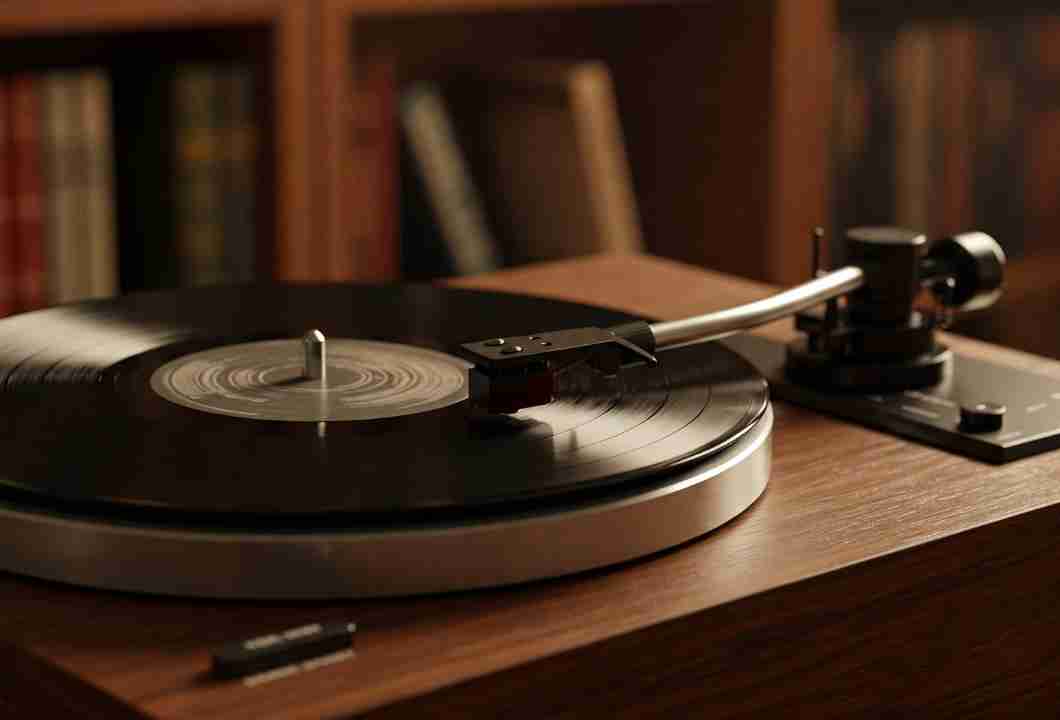
Living in an apartment does not mean compromising the experience of listening to vinyl at its best. In fact, many of the most refined vintage audio systems operate in compact urban spaces. The real challenge lies in understanding how a turntable behaves mechanically and electrically — and how apartment environments introduce specific problems such as ground hum, structural vibration, and acoustic feedback.
This article approaches the subject from a diagnostic and solution-oriented perspective, aligned with the clinical mindset used in professional turntable restoration. What follows is not a list of generic tips, but a structured method to design, assemble, diagnose, and refine a vintage turntable setup that performs quietly, stably, and musically — even in high-density residential buildings.
Understanding the Apartment Environment as a System
Before touching the turntable itself, the apartment must be treated as part of the audio chain. Unlike dedicated listening rooms, apartments introduce three critical variables:
- Shared electrical grounding
- Structural resonance transmitted through floors and walls
- Limited freedom in speaker placement and isolation
Ignoring these factors leads to persistent hum, low-frequency rumble, and feedback that no cartridge or stylus upgrade can solve on its own.
A vintage turntable is a precision electromechanical device. Treating it as such means diagnosing the environment first, then adapting the system to it — an approach echoed throughout Floating Floors in Apartments: How to Keep Your Turntable from Becoming a Seismograph.
Electrical Hum: Diagnosis Before Treatment
Hum is one of the most common complaints in apartment setups — and also one of the most misunderstood.
Identifying the Type of Hum
Not all hum has the same origin. Correct diagnosis prevents unnecessary component replacement.
- 50/60 Hz steady hum: typically grounding-related
- Buzzing with higher harmonics: often caused by electromagnetic interference from power supplies, routers, or LED lighting
- Hum that changes when touching metal parts: indicates improper ground reference
Before making changes, listen carefully with the stylus lifted and the volume raised moderately. Note whether the hum changes when the turntable motor is on or off — a method consistent with the diagnostic logic used in Turntable with Hum (Rumble): How to Identify Whether It’s Grounding, Cable, or Phono Preamp.
Grounding a Vintage Turntable Correctly
Many classic turntables rely on grounding schemes designed for older electrical standards. In apartments, this can clash with modern building wiring.
Step-by-step grounding process:
- Connect the turntable ground wire directly to the phono preamplifier ground terminal
- If hum persists, temporarily disconnect the ground wire and listen again
- Test a single-point ground approach by powering all audio components from the same power strip
- Avoid connecting the turntable ground to wall outlets or plumbing, even if older advice suggests it
A properly grounded turntable should be electrically silent before music begins. Silence is the baseline of fidelity.
Vibration: The Invisible Enemy of Vinyl Playback
Vibration affects tracking accuracy, bass definition, and stereo imaging. In apartments, vibration usually comes from two sources: structure-borne vibration and airborne acoustic energy.
Floor-Borne Vibration
Suspended wooden floors and concrete slabs transmit footfall differently, but both can disturb a turntable.
Diagnostic test:
- Play a record at low volume
- Walk normally around the room
- Observe whether bass becomes unstable or the stylus reacts
- Lightly tap the equipment rack and listen for low-frequency thumps
Any audible response indicates insufficient isolation — a topic explored in depth in Isolation and Base: 5 Simple Solutions to Reduce Vibration (Without Spending Much).
Isolation Strategies That Actually Work
The goal is controlled decoupling, not softness for its own sake.
Proven approaches include:
- Wall-mounted shelves anchored into load-bearing walls
- High-mass platforms using stone, laminated wood, or composite materials
- Compliant feet tuned to the turntable’s weight and suspension design
Avoid overly soft solutions such as thick foam or unstable spring platforms unless they are specifically engineered for audio use.
Turntable Design and Its Interaction with Apartments
Different turntable architectures respond differently to apartment conditions.
Idler, Belt, and Direct Drive Considerations
- Idler-drive turntables offer excellent torque but require meticulous motor and idler restoration to avoid rumble
- Belt-drive turntables often isolate motor vibration better but can be sensitive to external movement
- Direct-drive turntables, when properly serviced, combine speed stability with low mechanical noise, making them particularly suitable for apartments
The choice should be guided by restoration quality, not reputation — a theme consistent with When It’s Worth Restoring and When It’s Better to Replace: Objective Criteria (Without Romanticizing).
Cartridge, Arm, and Compliance Matching
Many apartment-related vibration issues are amplified by incorrect cartridge and tonearm matching.
Why Compliance Matters
Low-frequency resonance between tonearm and cartridge can be excited by building vibration, even if it is barely perceptible to the listener.
Step-by-step matching approach:
- Identify the effective mass of the tonearm
- Determine the dynamic compliance of the cartridge
- Aim for a resonance frequency between 8–12 Hz
- Adjust headshell mass or cartridge choice accordingly
This mechanical tuning often reduces feedback more effectively than isolation accessories alone, complementing concepts discussed in Modern Cartridges on Vintage Tonearms: When It Works, When It Mismatches, and Why.
Speaker Placement and Acoustic Feedback Control
Even at moderate listening levels, speakers can feed energy back into the turntable.
Apartment-friendly strategies:
- Place speakers on stands, never on the same surface as the turntable
- Avoid positioning speakers directly facing the turntable
- Reduce excessive bass reinforcement near corners and walls
A vintage setup prioritizes balance, not output. Controlled bass protects both sound quality and mechanical stability — reinforcing lessons from Where to Position a Turntable and Speakers in a Small Room (to Minimize Microphonics).
The Role of the Phono Stage
The phono preamplifier is where microscopic signals become vulnerable.
Key considerations:
- Use short, well-shielded interconnects
- Keep signal cables away from power adapters and transformers
- Favor phono stages with robust grounding architecture rather than excessive gain
Even a historically accurate restoration can be compromised by poor phono stage integration, as outlined in Vintage Phono Preamps: How to Choose by Cartridge Type and Noise Floor.
Preventive Maintenance as a Diagnostic Tool
In a turntable clinic context, maintenance is not just preservation — it is diagnosis.
Regular checks should include:
- Motor lubrication and noise evaluation
- Bearing inspection and cleaning
- Verification of speed stability
- Examination of internal wiring and solder joints
A restored turntable should not merely function; it should behave predictably and quietly under real-world conditions.
Educating the Listener: When “Record Player” Is Not Enough
The term record player is often used casually, but technically it refers to simplified playback devices. A true turntable is modular, serviceable, and adjustable — qualities that make proper setup and diagnosis essential, especially in apartment environments.
Understanding this distinction helps explain why careful grounding, isolation, and matching matter so much in vintage systems.
Bringing Silence, Stability, and Music Together
A successful vintage turntable setup in an apartment is the result of informed decisions, not luck. Each source of hum or vibration is a symptom pointing to a specific imbalance — electrical, mechanical, or acoustic.
By diagnosing before adjusting and respecting the physics behind analog playback, it becomes possible to achieve a listening experience that feels both intimate and authoritative.
When the stylus drops into the groove and the background remains black, when bass is firm without bloom, and when music emerges without distraction, the apartment disappears. What remains is the quiet confidence of a turntable operating exactly as its designers intended decades ago — proof that vintage audio, when properly understood and restored, adapts beautifully to modern living without surrendering its soul.