In the restoration workshop, few complaints are as intriguing—and as diagnostically revealing—as this one: “The noise only appears when I touch the tonearm.” At first glance, it sounds like a minor annoyance. In practice, it is one of the clearest signals a turntable can give. This behavior almost always points to grounding faults, oxidation, broken signal paths, or improper mechanical–electrical continuity.
Unlike constant hum or intermittent crackle, this symptom is conditional. It only appears when the user becomes part of the system. Understanding why human touch triggers the noise is essential not only to fix the problem correctly, but to preserve the electrical integrity of vintage audio equipment. Many cases begin exactly like this and later evolve into broader faults explored in Turntable with hum (rumble): how to identify whether it’s grounding, cable, or phono preamp.
Why Touching the Tonearm Reveals the Fault
When you touch the tonearm and a hum, buzz, or crackle suddenly appears, your body is acting as an antenna. The human body naturally absorbs electromagnetic interference from the environment—mains wiring, power supplies, lighting, and RF noise.
In a healthy turntable, proper grounding and shielding route that interference safely to ground before it reaches the phono signal. When grounding is incomplete or interrupted, that interference is injected directly into the signal path.
This explains a critical diagnostic clue:
the noise is not constant. It is not motor-related, not platter-related, and rarely cartridge failure. It appears only when your body completes or disturbs a faulty electrical reference.
That observation alone narrows the fault domain dramatically and distinguishes it from issues like Constant Hiss vs. Occasional Pops: What’s Normal in Vinyl and What Signals a Problem.
How the Tonearm Signal Path Really Works
To diagnose this properly, it helps to remember how fragile a phono signal truly is.
A cartridge outputs a signal measured in millivolts. That signal must travel cleanly through:
- Cartridge pins
- Headshell leads
- Tonearm internal wiring
- Tonearm base junction
- RCA cables or terminal strip
- Phono preamp input
Any oxidation, resistance change, or floating reference along this path becomes audible. Unlike line-level audio, the phono signal has virtually no tolerance for instability.
When touching the tonearm introduces noise, it means shielding or grounding has failed somewhere in this chain, even if the turntable otherwise “works.”
The Most Common Causes of Noise That Appears Only When You Touch the Tonearm
1. Broken or Floating Ground Wire
This is the most frequent root cause.
Many turntables rely on one (or more) of the following grounding schemes:
- A dedicated ground wire to the amplifier
- Internal bonding between tonearm tube and signal ground
- A shared ground through RCA shields
If that ground path is broken, oxidized, or poorly soldered, the tonearm becomes electrically floating.
Typical signs:
- Noise decreases when touching other metal parts
- Hum intensity changes depending on where you touch
- Noise reduces when holding the ground wire manually
These symptoms strongly overlap with cases detailed in Turntable Only Makes Noise When Other Devices Turn On: Step-by-Step Ground Loop Diagnosis, but here the trigger is physical contact rather than external equipment.
2. Oxidized Headshell Contacts
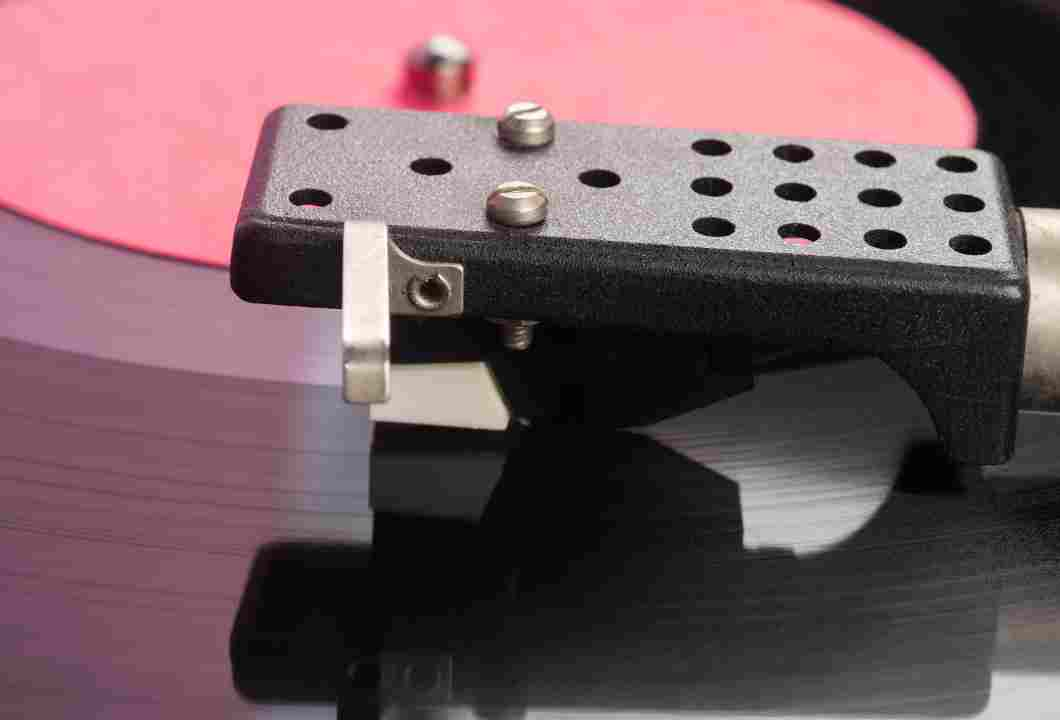
Detachable headshells are a classic weak point in vintage turntables.
Oxidation on:
- Headshell pins
- Tonearm socket contacts
creates unstable grounding. When you touch the arm, microscopic movement or pressure changes contact resistance, causing the noise to appear or shift.
This fault is frequently misdiagnosed as cartridge failure, even though the cartridge itself is electrically fine. It also intersects with compatibility and contact issues discussed in Headshell and Mounting Standards: Compatibilities No One Explains.
3. Internal Tonearm Wire Fatigue
Inside the tonearm are ultra-thin wires, often 33–36 AWG. Over decades, they suffer from:
- Hairline fractures
- Cold solder joints
- Partial continuity loss
Touching the tonearm slightly flexes the structure, momentarily altering continuity. The resulting noise is the audible symptom of that micro-instability.
This is especially common in units that “worked fine for years” before restoration.
4. Poor Ground Bond Between Tonearm Tube and Bearing Assembly
Many tonearms rely on metal-to-metal contact between:
- The arm tube
- The bearing housing
- The grounding point
Old grease, oxidation, or improper reassembly can electrically isolate the arm tube while leaving mechanical movement unaffected.
The tonearm looks perfect, tracks fine—but electrically behaves like an antenna.
5. RCA Cable Shield Failure
In some designs, the tonearm ground is tied directly to the RCA cable shield. If that shield is compromised near the exit point or strain relief, touching the arm injects noise because the reference ground is unstable.
This failure mode is common in turntables with permanently attached cables, and often accompanies symptoms described in Cabling: When Replacing Cables Helps — and When It’s Placebo.
Step-by-Step Diagnostic Process Used in Restoration Clinics
Step 1: Eliminate External Variables
- Test with a known-good phono preamp
- Confirm amplifier grounding is correct
- Remove other sources of interference
Never diagnose a turntable in an unstable system.
Step 2: Test Ground Continuity
Using a multimeter:
- Tonearm tube → ground wire
- Tonearm tube → RCA shields
- Cartridge ground → system ground
Readings should be stable and near zero ohms. Fluctuation indicates broken or oxidized paths.
Step 3: Inspect Headshell and Cartridge Connections
- Remove the headshell
- Clean contacts with proper electronics cleaner
- Inspect clips for looseness or corrosion
Never bend cartridge pins to “improve” contact—this creates permanent damage.
Step 4: Controlled Touch Testing
At low volume, carefully touch:
- Tonearm tube
- Bearing housing
- Ground terminal
- RCA shields
Each reaction narrows the fault location logically.
Step 5: Inspect Internal Tonearm Wiring
If all external points pass:
- Open the bottom cover
- Inspect solder joints at the tonearm base
- Look for brittle insulation or stressed wires
This step requires patience. Rushing destroys irreplaceable parts.
Corrective Solutions That Actually Last
Proper Ground Restoration
Do not add random ground wires. A professional fix:
- Respects the original grounding topology
- Uses low-resistance paths
- Avoids ground loops
Blind grounding often creates new noise issues.
Tonearm Rewiring (When Necessary)
Rewiring is not an upgrade—it is surgery.
It requires:
- Correct wire gauge
- Flexible, low-capacitance conductors
- Proper strain relief
Done correctly, it restores silence and tracking integrity simultaneously.
Contact Rehabilitation Before Replacement
In many cases, cleaning and reseating original contacts preserves originality and value better than replacing parts.
Replacement should be the last resort, not the first instinct.
Why This Symptom Should Never Be Ignored
A turntable that hums only when touched is electrically compromised. Left unresolved, it can:
- Stress cartridges
- Load phono preamps incorrectly
- Mask deeper wiring failures
- Reduce resale and historical value
Small symptoms in vintage audio often point to large underlying truths.
From Repair to Craftsmanship
Noise that appears only when touching the tonearm is one of the clearest conversations a turntable can have with its technician. It tells you where the signal loses reference, where time has weakened the original design, and where careful restoration separates a functioning device from a truly silent musical instrument.
Whether restoring a reference-grade turntable or preserving a classic record player, mastering this diagnosis elevates the work from repair to craft.
The silence that follows a correct fix is not accidental.
It is earned—through understanding, patience, and respect for the engineering hidden inside that beautifully spinning platter.