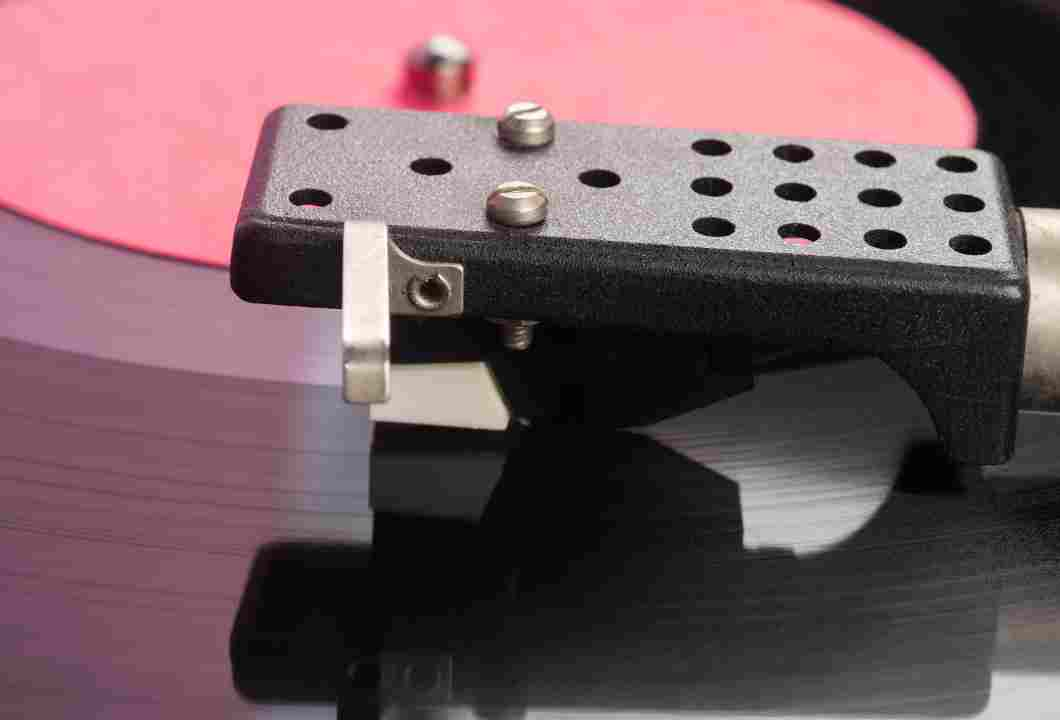

Vinyl playback can feel unusually “alive,” but it also exposes a limitation that digital formats never have to confront: the stylus must trace a shrinking circle of increasingly dense information with the same stability it had at the outside edge. When that stability breaks down, the end of the side becomes the trouble zone.
Inner groove distortion (IGD) is one of the most common complaints in a turntable clinic because it’s both predictable and fixable—but only if you treat it as a geometry + setup problem, not a “bad pressing” reflex.
What Inner Groove Distortion Sounds Like
IGD typically shows up as:
- harsh or fuzzy treble near the label
- “spitty” vocal sibilants (S / SH)
- reduced clarity when the mix gets busy
- a sense the cartridge is “struggling” even though the record looks clean
If it happens across multiple records in the same pattern, that consistency is a diagnostic gift: the issue is almost always in the playback system.
Why the End of the Record Is Harder
Lower groove speed, higher difficulty
A record spins at constant RPM, but the groove moves slower under the stylus as it approaches the center. That means:
- the same music must fit into less groove length (higher density)
- high frequencies require sharper, tighter groove changes
- the stylus has less “room” to trace those changes cleanly
So the inner grooves are where alignment, stylus shape, and tracking stability get tested hardest.
The Core Mechanism: Tracking Error
Most turntables use a pivoted tonearm. A pivoted arm can only be perfectly tangent to the groove at two points (null points). Everywhere else there’s a slight angle error—and that error increases toward the inner grooves.
When that error is made worse by misalignment, the stylus loads the groove walls unevenly, and high-frequency distortion becomes inevitable.
This is also why “it sounds fine at the start of the side” is not a defense. Outer grooves are forgiving; inner grooves are not.
The Most Common Causes of IGD
1) Cartridge alignment is off
This is the #1 cause in clinic work. Typical mistakes:
- wrong overhang
- cartridge body not square to the grid
- alignment method that doesn’t match the arm’s realities
- “close enough” alignment that only collapses at the inner null point
When alignment is correct, IGD drops dramatically even without changing hardware. If you suspect the headshell itself is introducing geometry or azimuth errors, revisit Headshell and Mounting Standards: Compatibilities No One Explains.
2) Stylus profile can’t trace inner groove complexity
Conical tips struggle most. Ellipticals do better. Line-contact shapes (MicroLine/Shibata/etc.) can reduce IGD significantly—but only if alignment is precise.
If you want a clean mental model of the tradeoffs (and why advanced profiles punish sloppy setup), see Elliptical, Conical, or Microlinear Stylus: Audible Differences and Risks for Vintage Records.
Also: a worn stylus can “pass” outer grooves and fail inner grooves first. If stylus history is unknown, treat it as unknown. The safest workflow is in How to Identify the Correct Turntable Stylus in 10 Minutes (Without Falling for “Similar” Replacements).
3) Tracking force is too low
Under-tracking is one of the fastest ways to create end-of-side distortion. Inner grooves demand control; low VTF allows micro-mistracking that shows up as sibilance and fuzz.
Set VTF with a scale (not the dial), and don’t be afraid to run the upper half of the manufacturer’s range if inner grooves are your problem. The disciplined method is in Tracking Force and Anti-Skate: How to Choose Safe Values for Your Cartridge.
4) Anti-skate is wrong (often slightly wrong)
Anti-skate errors don’t always sound like “channel imbalance.” Often they sound like:
- IGD worse on one channel
- vocals getting spitty on the same side consistently
- distortion that increases as the stylus moves inward
Start near the VTF value, then fine-tune using inner-groove vocal sibilants and dense cymbal content. Again: Tracking Force and Anti-Skate: How to Choose Safe Values for Your Cartridge.
5) VTA/SRA is far from reasonable
VTA is often treated like audiophile fine-tuning, but large errors are not subtle—especially at the end of a side. A visibly tail-down or tail-up arm can make high-frequency tracing less stable.
Clinically, the goal is simple: begin with the arm roughly parallel to the record and only adjust if the symptom clearly tracks with arm height changes.
6) The record itself is already damaged—or cut aggressively
Some inner groove distortion is “baked in”:
- inner grooves worn by past mistracking or bad styli
- hot cuts pushed close to the label
- certain pressings that simply stress the format
This is why you must test multiple records. If only specific records distort and the pattern doesn’t follow your setup, the limitation may be the disc.
If you need a disciplined way to inspect used records before blaming your system, use Buying Used Vinyl: A Complete Inspection Checklist (Record, Jacket, and Mold Warning Signs).
A Clinic-Style Fix Sequence
Step 1: Confirm stylus condition
If hours are unknown, assume risk. Inspect or replace. No adjustment can “undo” a worn contact shape.
Step 2: Set VTF precisely
Use a digital gauge. Start at the midpoint, then move slightly higher within spec if IGD persists.
Step 3: Align the cartridge carefully (especially the inner null)
Take your time. IGD improvement is usually alignment-driven, not “upgrade-driven.”
Step 4: Dial anti-skate using inner-groove listening
Use vocal sibilants and cymbal decay near the end of the side. Aim for equal behavior left/right.
Step 5: Confirm the arm is behaving mechanically
If you chase alignment forever and nothing holds, check for mechanical problems: bearing play, headshell connector slop, or a cartridge/arm mismatch. The compatibility logic is laid out in Modern Cartridges on Vintage Tonearms: When It Works, When It Mismatches, and Why.
Step 6: Re-test across multiple records
If the problem is global, it’s your system. If it’s record-specific, it’s likely wear or the cut.
Why Solving IGD Matters Beyond Sound
Reducing inner groove distortion improves:
- record longevity (less groove stress)
- stylus life (less violent contact)
- listening comfort (less fatigue)
- confidence that your setup is telling the truth
In a restoration mindset, IGD isn’t just “the last two minutes sounding worse.” It’s a measurement you can hear—proof that geometry, force, and stylus behavior are either cooperating or not.
When they finally cooperate, the end of the side stops being the danger zone and becomes the confirmation that your turntable is truly under control.