In the world of vintage audio restoration, few complaints are as deceptively simple—and as technically revealing—as the listener who insists the record is flawless, the stylus is new, and yet the sound remains dull, congested, and lacking air. When a turntable consistently delivers a “closed” or veiled presentation even with high-quality pressings, the issue is rarely subjective taste. In clinic-level diagnosis, this symptom almost always points to a measurable deviation somewhere between the cartridge pins and the line-level output.
Two suspects dominate this territory: incorrect RIAA equalization and a malfunctioning phono preamp. Before chasing cartridges or blaming pressings, those foundations must be verified.
Understanding What “Closed” Sound Really Means
Before touching a screwdriver or oscilloscope probe, the symptom itself must be defined precisely. In vinyl playback, a “closed” sound typically presents as:
- Rolled-off high frequencies
- Reduced harmonic detail
- Constricted spatial cues
- Overemphasized low-midrange
- A fatiguing or muddy character
Crucially, this character persists across multiple records, including trusted reference pressings. That consistency rules out groove wear or mastering variance and redirects attention to the playback chain.
If the system sounds consistently muted rather than intermittently noisy, the distinction from issues like Why Your Turntable Crackles Only After Warm-Up: Diagnosing Heat, Oxidation, and Intermittent Failures becomes important. One points to instability; the other points to incorrect transfer.
Why RIAA Equalization Is Non-Negotiable
Vinyl records are not cut flat. During mastering, bass frequencies are attenuated and treble frequencies boosted to optimize groove geometry and reduce surface noise. Playback requires the exact inverse curve to restore tonal balance. This curve is defined by the RIAA standard.
When RIAA equalization is even slightly off—particularly in the high-frequency turnover points—the result is rarely dramatic distortion. Instead, it manifests as something far more deceptive: a subtle but persistent loss of openness and air.
Common Causes of RIAA Deviation
- Aging capacitors drifting out of tolerance
- Incorrect component values from past repairs
- Non-standard or “modified” RIAA networks
- Poor-quality passive components in budget designs
In vintage equipment, capacitor drift alone can shift the treble roll-off enough to make cymbals lose shimmer and vocals recede unnaturally.
This is why closed sound complaints so often originate not at the cartridge, but downstream—something reinforced by the diagnostic logic in How to Choose the Right Phono Preamp for a Vintage Turntable.
The Phono Preamp: Silent Gatekeeper of Clarity
A phono preamp is not simply a gain stage. It is a precision equalization device operating at microvolt levels. Any error here is amplified—literally and perceptually.
Preamp-Related Faults That Commonly Cause Closed Sound
- Loss of gain in high-frequency stages
- Aging transistors or op-amps
- Incorrect loading (impedance or capacitance mismatch)
- Power supply ripple or voltage sag
- Thermal drift affecting bias stability
A phono preamp can still “work” while operating far outside its original specification. In restoration practice, this gray zone accounts for a large percentage of veiled-sounding systems.
If the preamp is integrated into a vintage amplifier, this behavior often overlaps with symptoms explored in Turntable with Hum (Rumble): How to Identify Whether It’s Grounding, Cable, or Phono Preamp—even when hum itself is not obvious.
Turntable vs. Record Player: Why Terminology Matters
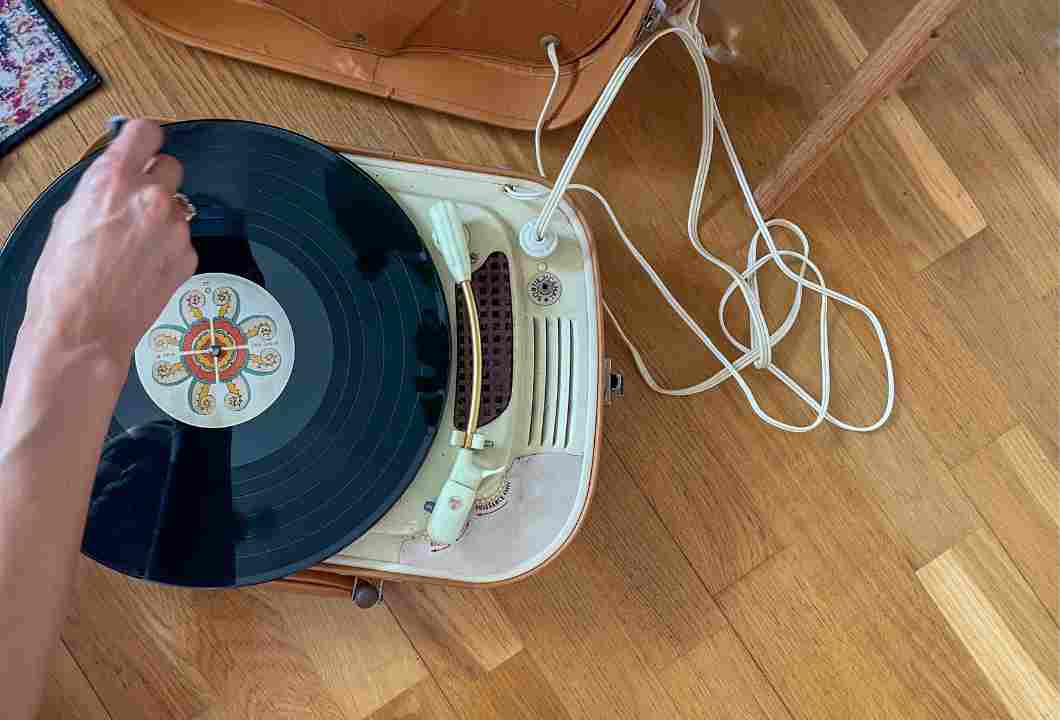
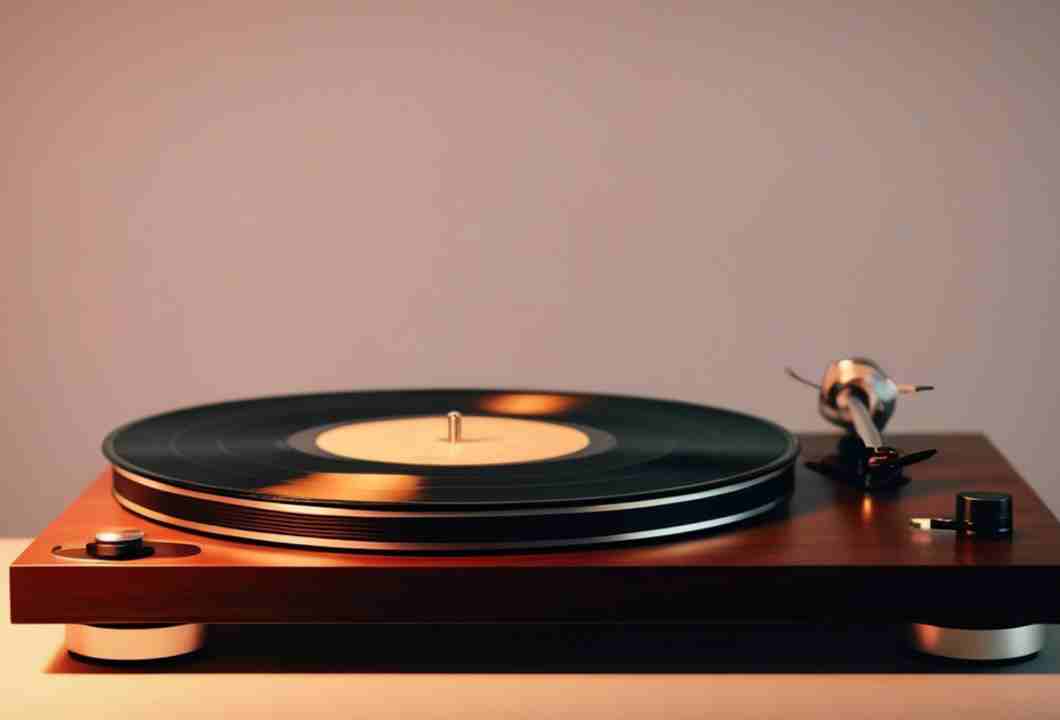
In technical restoration, precision in language reflects precision in thinking. A turntable is a modular system: platter, motor, tonearm, cartridge, and external electronics. A record player is typically a self-contained unit with integrated amplification and speakers.
This distinction matters because a closed sound is far easier to isolate—and correct—when each stage can be evaluated independently. In integrated designs, faults in the phono stage are often mistaken for cartridge limitations.
Step-by-Step Diagnostic Process
Step 1: Establish a Known Reference
Play the same record on a reference turntable and phono preamp known to be within specification. If openness and air return immediately, the vinyl itself is absolved.
Step 2: Verify Cartridge Loading
Confirm the manufacturer’s recommended load:
- MM cartridges: typically 47kΩ / 100–300pF
- MC cartridges: variable, often 100Ω or lower
Excessive capacitance is one of the most common—and most overlooked—causes of high-frequency attenuation, especially with MM designs.
Step 3: Measure RIAA Accuracy
Using a test record and analyzer, examine frequency response across the spectrum. Pay close attention above 5 kHz. Deviations here correlate directly with perceived dullness.
Step 4: Inspect and Test Passive Components
In vintage phono stages, electrolytic capacitors should be considered consumables. Measure resistors in the RIAA network for drift; even a 10% deviation can audibly alter tonal balance.
Step 5: Evaluate Power Supply Health
Ripple or undervoltage reduces headroom and compromises high-frequency clarity. Oscilloscope verification is strongly recommended in any serious restoration.
Step 6: Listen After Each Intervention
Never batch modifications. Restore, test, listen. Measurements guide the work, but the ear confirms whether neutrality has been restored.
When the Problem Isn’t RIAA—but Masquerades as Such
Several issues can mimic RIAA deviation while originating elsewhere:
- Worn or misaligned stylus reducing high-frequency retrieval
- Oxidized tonearm wiring increasing resistance
- Interconnect cables with excessive capacitance
- Grounding issues subtly masking detail
This is why isolation matters. Articles like How to Identify the Correct Stylus for Your Turntable in 10 Minutes and Headshell and Mounting Standards: Compatibilities No One Explains often intersect directly with “closed sound” complaints.
Restoration Philosophy: Accuracy Over Flavor
In vintage audio, it is tempting to “tune by taste.” While voicing has its place, solving a closed sound problem requires technical neutrality. The objective is not brightness—it is correctness.
A properly equalized turntable does not sound exaggerated or etched. It sounds effortless, because nothing is being withheld.
Bringing the Music Back to Life
When RIAA equalization is restored to specification and the phono preamp operates within its intended parameters, the transformation can be striking. Air returns. Transients breathe. The soundstage expands—not because anything was added, but because nothing is missing anymore.
For the listener, it feels like rediscovering familiar records. For the technician, it is quieter satisfaction: the system is finally telling the truth. And in analog restoration, truth—not flavor—is the highest fidelity of all.